
The Secret to a Long-Lasting Epoxy Floor: Proper Concrete Preparation
Updated: Aug 6
If you want an epoxy floor that actually lasts, let’s be honest: everything comes down to what happens before resin touches the ground. Skip the prep work, and it’s only a matter of time before the floor peels, bubbles, or delaminates. The secret to a lifetime-guaranteed finish isn't the shiny topcoat—it’s how we treat the concrete underneath.
We prep every surface to open up the concrete's natural pores so the epoxy can lock in mechanically and hold on for good.
The Grinding Difference: Clean vs. Contaminated Concrete
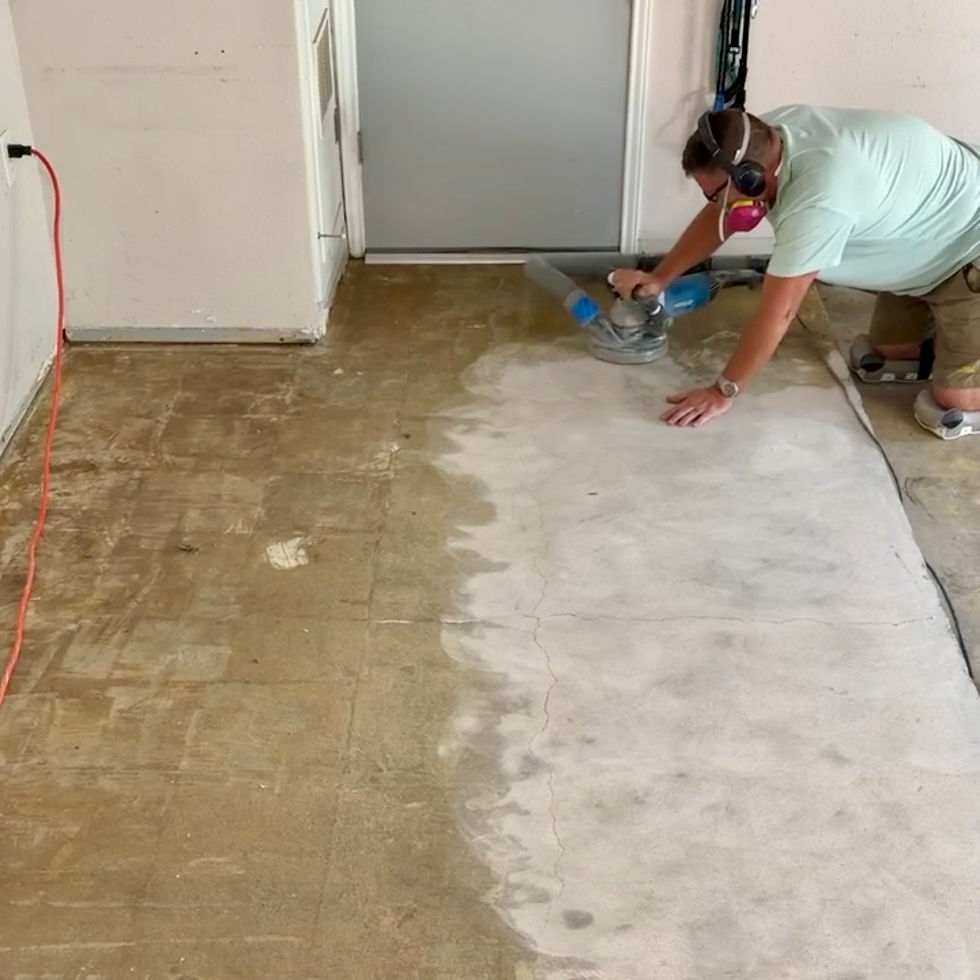
Look at the above photo. The visual difference between an unprepared and a properly prepared floor tells the whole story:
The Unprepared Side: This shows a dirty, contaminated concrete surface holding onto old tile mastic, glue, or grime. If you put epoxy over this, it’s just bonding to the dirt, not the actual concrete.
The Prepared Side: Using a handheld 7-inch diamond grinder with a HEPA vacuum attachment, we strip away that top micro-layer. This exposes clean, porous concrete and opens up the slab's capillary network so the epoxy primer can fuse deep inside.
Why Mechanical Grinding Beats Acid Etching
Many DIY kits tell you to use muriatic acid, but professional installers rely strictly on mechanical diamond grinding for a few very solid reasons:
The Right Texture (CSP 2 to CSP 3): Professional primers need a Concrete Surface Profile that feels like 80-grit sandpaper. Acid etching rarely achieves this evenly, especially on tough, hard-troweled concrete.
Beating Sealers and Oils: Acid can't penetrate old paint, acrylic sealers, or oil stains—it just beads up and sits there. Diamond grinders slice right through these barriers.
No Extra Moisture: Acid etching dumps gallons of water into your slab. Because concrete acts like a sponge, you have to wait days for it to dry out before coating. Grinding is a completely dry process, meaning we can get right to work.
Our Professional Prep Process
Surface Assessment & Inspection (Available Upon Request): We’ve been doing this long enough to spot the usual warning signs of moisture or dense concrete right away. Formal moisture and hardness testing aren’t part of our standard process, but we are always happy to run them if you'd like extra peace of mind before we begin.
Full-Surface Diamond Grinding: Most of the time, we use heavy-duty planetary grinders or rotary machines across the main floor and specialized hand grinders for edges and corners. This guarantees a uniform, perfect grip profile across 100% of the space.
Crack and Divot Repair: Once the floor is ground, every hidden crack, pit, and joint is exposed. We chase them out, fill them with a rapid-cure polyurea or epoxy joint filler, and grind them completely flush so they vanish under your new floor system.
HEPA Dust Extraction: Even microscopic dust acts as a bond-breaker. We run industrial HEPA-filtered vacuum systems to keep the workspace clean and the concrete pores wide open.
Frequently Asked Questions
Do you fix cracks and holes before applying the epoxy? Yes. Once the concrete is profiled, we chase and fill every crack, divot, and joint using a high-performance, rapid-cure polyurea filler, grinding them completely flush so structural flaws vanish invisibly beneath your new system.
What do I need to do to prepare my space before your crew arrives? Completely clear the floor and lower wall spaces so our heavy machinery can maneuver freely. Please do not pressure wash, as trapped moisture compromises the epoxy bond. If you have a refrigerator or heavy storage units, plan to relocate them outside the work zone 24 hours prior.
Can you grind and epoxy a floor with deep oil stains or chemical spills? Yes, with proper evaluation. While diamond grinding removes most surface contaminants, deep-set chemical penetrations require specialized prep or bonding primers. Sending us a photo and brief history beforehand allows us to map out the solution.
How long does the prep and grinding process take for a standard two-car garage? Typically 3 to 4 hours, though complex jobs involving heavy old coatings, high concrete hardness, or extensive crack repairs can extend up to a full day. Thorough prep cannot be rushed if you want a lifetime-guaranteed floor.
Will the grinding process make a lot of noise or disturb my neighbors? Industrial diamond grinding is inherently loud, but that noise is the sound of absolute surface integrity being achieved. A quick neighborly heads-up is recommended, and the results usually speak for themselves when they see the final transformation.
Let’s Talk About Your Space
Ready to upgrade your garage, workshop, or commercial floor? Send us a quick note with your approximate square footage and what your floor looks like right now. We’d love to chat about how we can give you a durable, great-looking finish that stands the test of time right here across Texas.


Comments